

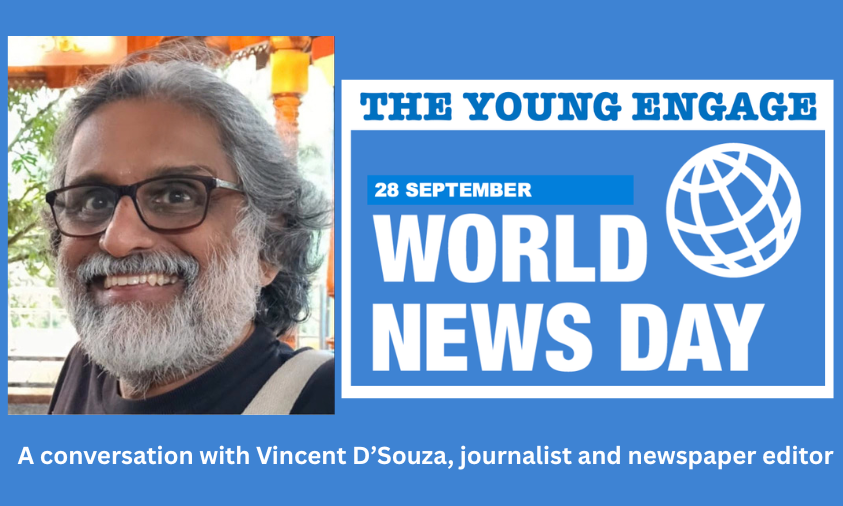
How does a journalist know whether a piece of information is reliable? What happens when the pressure to be first gets in the way of getting it right? And in a world of social media, instant updates and AI-generated content, how do we decide which news to trust?
For World News Day, YOCee student reporter Nandhini A, put these questions to Mr. Vincent D’Souza, a veteran journalist and the founder-editor of Mylapore Times, a neighbourhood newspaper in Chennai, India.
In this audio interview, Mr. D’Souza shares insights from more than four decades of experience in journalism. He talks about checking sources, cross-checking information and knowing when to pause before publishing a story. He also shares his thoughts on headlines, social media, the temptation to chase popular stories, and the importance of keeping news relevant and in context.
One message comes through clearly: being first is not the same as being right.
The conversation looks at the responsibilities of both those who report the news and those who read, watch and share it.
Listen to Nandhini’s interview with Mr. Vincent D’Souza as part of YOCee’s World News Day project.
Click the Play button >>>
Transcript:
Choosing Trusted Journalism – Interview with Vincent D’Souza
NANDHINI : Hello, fellow journalists and avid news consumers. We are approaching World News Day. And aligning with this year’s theme of Choosing Trusted Journalism, we have with us Mr. Vincent D’Souza, a Chennai-based journalist and media entrepreneur, and the founder-editor of the Mylapore Times. He also founded and co-founded a few other neighbourhood newspapers. He began his journalism career in 1980 and has worked with publications including The Week and The Indian Express. Besides serving as a BBC radio stringer, he has also covered major events including the 1998 Coimbatore bomb blasts. Alongside journalism, he has also started reporting and founded KacheriBuzz.com, a platform focused on South Indian classical music and dance. With decades of experience in journalism, we have seen the industry change dramatically from traditional newspapers and radio to today’s fast-moving digital news environment.
So, with that perspective, let’s dive into what trusted journalism means today.
NANDHINI : So, to begin with, how do journalists establish that the information they are reporting is reliable and is worth the public’s trust?
VINCENT D’SOUZA: First of all, a journalist needs to have a broad understanding of the subject that he is dealing with, which means he is able to appreciate the quality, the source, and the gravity of the information that is coming into him – be it crime, be it environment, be it whatever.
Two, we need to know – and this comes from a bit of experience, “who is the source of this information?”
There are times when your training allows you to understand how deep, how solid this information is. But if there is a doubt that creeps in about the validity or the weight of the information, then it is better to check back on the source of this information.
NANDHINI : How do newsrooms balance speed with accuracy?
VINCENT D’SOUZA: I guess if you are in doubt, they say, “Leave it out.”
So, at that point in time, I think the speed – especially in today’s world of instant news and breaking news – my suggestion is to just hold it back, take a deep breath, look at what you have, then put it out.
Then look at the TV screens and social media and say, “Everybody has put it out, let’s also put it out.”
NANDHINI : How do headlines and context influence the way readers understand the story?
VINCENT D’SOUZA: Very much about headlines and lead paragraphs. You can twist them around, but I think most readers would just want it simple and straight.
NANDHINI : How has this era of social media and the rise of AI changed the responsibilities of journalists?
VINCENT D’SOUZA: Social media has had a huge impact on mainstream journalism. They are now part of the social media journalism itself. But what happens is, you get tempted to do pop stories, which get you better readership or viewership, and move you away from the serious journalism that you have been into.
NANDHINI : What should young people look for before they decide if a news source is reliable or not?
VINCENT D’SOUZA: Is a news source reliable? One is that, much depends on how well you cultivated your sources. If you know them well, then you know if you can trust them and what they’re sharing. But even with those kinds of sources, whatever they are giving you, cross-checking with a second party makes you more comfortable.
Don’t rely on your source completely because there could be, in today’s world, someone manipulating them. And we have had cases where it has led to a huge amount of embarrassment. You need to double-check.
NANDHINI : If you could fix one thing about how news is made or consumed in our country, what would it be?
VINCENT D’SOUZA: Not very sure about what we can fix. All that we can do is – as journalists and publishers and editors, we put out the news, and I think what should guide us all the time, what we need to fix, is to make sure to tell your colleagues and teammates to focus on what is relevant for the day, the context for the day, and keep at it rather than chasing soft pop stories or pop angles in a serious story. That’s something that we need to pay attention to.
NANDHINI : And with that, we come to the end of the conversation with Mr. Vincent D’Souza.
From understanding how journalists verify information to navigating the challenges of speed, social media, AI, and changing news habits, today’s conversation has highlighted that trust in journalism is not simply given; it is built through accuracy, context, responsibility, and credibility.
A big thank you to Mr. D’Souza for taking the time to share his experience and insights with us.
And to everyone watching or listening, especially young news consumers, the next time you come across a headline, remember to pause, question, and look beyond the surface.
This is Nandhini, a student intern at YOCee, wishing you a meaningful World News Day. Stay curious, stay informed, and most importantly, choose trusted journalism.
#WorldNewsDay #ChooseTrustedJournalism #YourRightToKnow

When YOCee’s student reporters get busy, the team at YOCee’s small office takes up the role of the reporters, does the rounds, writes copies and files reports. The team also posts useful info and ePapers produced in-house.