
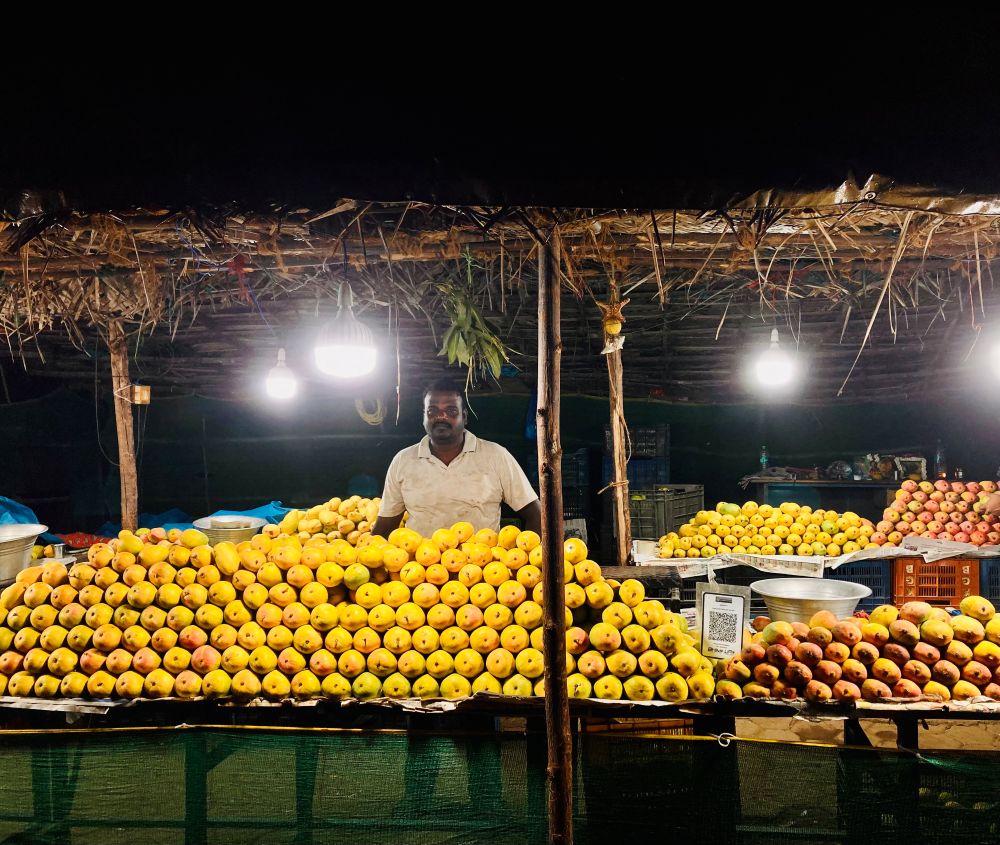
Summer has arrived in Chennai, and with it returns its prodigal yellow fruit that everyone knows and loves. The mango, dubbed ‘king of fruits’, is here to stay for the next few months. Let’s get to know our sweet (not always) summer guest and its cousins.
A short conversation with a mango seller Suresh, in the Navalur area, reveals many hidden facts and stories about these fruits. The stall is set on the side of the OMR, on the main road. It had just rained a brief summer shower, so there was a strange humidity rather than heat in the air. One could assume that mangoes thrive mostly in the heat, but Suresh mentions that these rains, also called ‘mango showers,’ can sweeten the mangoes as well. These rains, accompanied by thunderstorms, are a key factor in mango ripening. For everyone else, it’s a break from the scorching heat that comes with summer.
Among the eight varieties in his stall, Suresh says the Banganapalle becomes “a 100% sweeter while others only by 90%” during these mango showers. This mango, the common man’s favourite, is a butter-yellow colour and is used in making various desserts.
Suresh next introduces the tinier Kalapadi, which he refers to as ‘Kalapani’. Even fruit names can be changed colloquially, it turns out. While the fruit he sourced was from Vellore, this mango originates from the Kalapadi village in the Perambalur district. He mentions that it is grown in areas like Theni and Madurai as well. Do not be fooled by its size; this fruit is packed with intense sweetness.
Opposite to the Kalapadi fruit sits a neatly arranged pile of mangoes with a hue of yellow and orange. “Alphonsos are grown everywhere these days; they don’t come from a particular place,” says Suresh. “One interesting thing about them is their Impon Suvai (pronounced eye-m-ponn soo-vai), meaning that they have five different tastes, including sweet, tangy, and a tiny hint of spice as well,” he adds. They are well known in the south in this identity, but in North India, the mangoes go by the name Hapos. But this mango was given its exotic name ‘Alphonso’ when a Portuguese general, Afonso de Albuquerque, who interbred many mangoes of Goan origin, created what is now the ‘King of mangoes’.
There is now a pile of mangoes that looks about the same size as the Alphonsos. Suresh picks one up and indicates the blaring shade of crimson above the usual yellow and green. “This is the Sindhura, and it derives its name from the ‘sind’ part, which shows the bright vermillion colour of the mango”. He says. This mango is a Tamil local, known to have a very tender pulp, making it ideal for icecreams, milkshakes and juices.
Suresh now shows a shapely mango. “Javadhu”, he declares. “Straight from the Javadu Hills, it is known for its sweet aroma”. Indeed, the mango got its name from an aromatic perfume, made from herbs that also grow in the hills, which has a fragrant and intense profile. Suresh has three other mango varieties apart from these. The malgova, he says, while holding a nearly round fruit, is grown primarily in Salem.
“The best-selling fruit I have is the Imam Pasand right here.” This fruit goes way back to the era when it was the favourite of Mughal emperor Humayun, hence its royal name. “This fruit is also well known in Tamil Nadu due to the Thathachariar Gardens”, Suresh says, referring to the famous family-run orchard of Imam Pasand Mangoes in Srirangam, Trichy.
On top of this, Suresh also has a stock of mangoes of the Thailand variety, the NRI cousin of Indian Mangoes! He clarifies, “These fruits are of Thai variety, but they are actually grown here only, in Puthupakkam”. He also adds, “The climate is pretty suitable for this fruit, like in Thailand. I would say it’s even better”
A mango seller like Suresh not only knows his products well but also how they are taken care of. “During the month of Aadi (July-August 17th), natural fertilisers such as cow and goat dung are used before the flowering process begins,” he says. “And during the month of Thai (January 14th-February 12th), government-authorised fertilisers are used to ensure all plants flower at the same time,” adds Suresh. Additionally, the uniform flowering helps in business as well, as he can start selling all his mangoes.
Behind their vibrant exterior, mangoes hide various flavour profiles and unique characters, from the sweet personality of the Kalapadito the jack-of-all-trades Alphonso. So next time you sip on a mango milkshake, savour some mango ice-cream, or bite into the fruit itself, ask yourself– which mango am I eating?
If you would like to bulk order mangoes from Suresh’s stall, here is his contact number– 9962236503
Cover photo by Harsha Prashanth

Student Intern during April – June 2026