

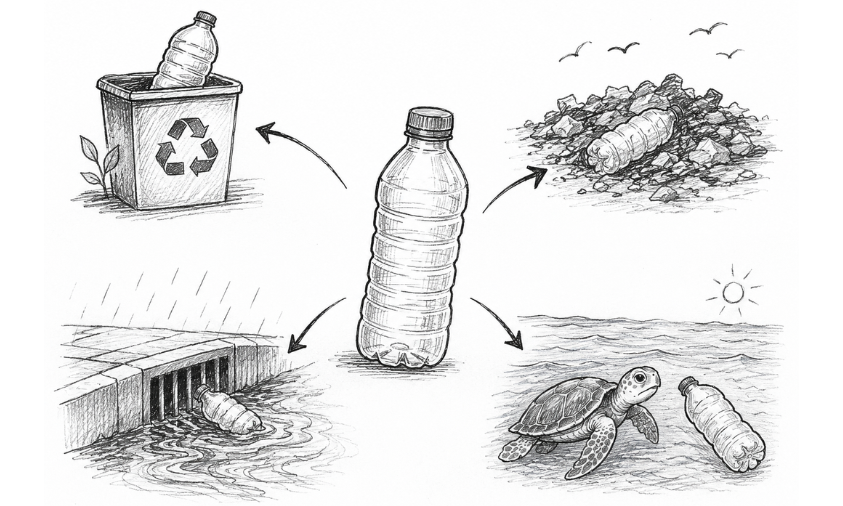
A clear bottle waits on a shop shelf. It is cold, light, cheap, and easy to carry. Someone buys it, drinks from it, and throws it away. For the person, the story is over. For the bottle, the story has just begun. The bottle is thrown to the side of the road. If you’re an environmentally aware citizen, you might drop it in the dustbin. Sometimes, people may throw it carelessly by the roadside and it rolls towards a pile of sand. From now on, there are four paths.
PATH-1
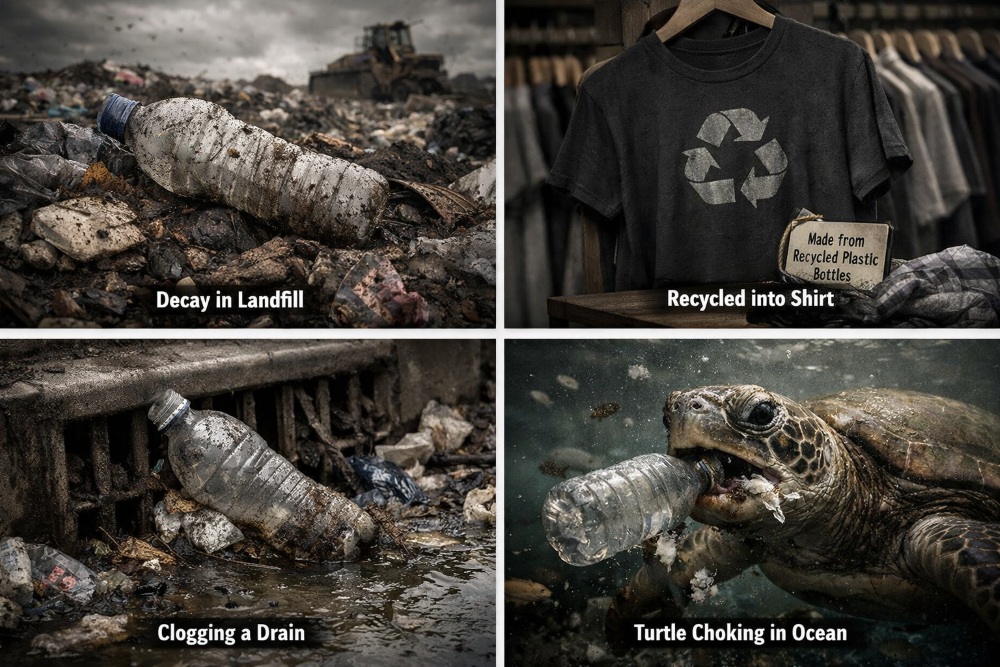
Someone notices the bottle and throws it into the dustbin. Later, the bottle is collected and taken to a recycling plant. It is crushed and torn apart. Plastic bottles are sorted, cleaned, and shredded into flakes. The flakes are melted and extruded through spinnerets to create polyester filaments, which are then spun into recycled fibre for textiles. A few months later, it could be part of someone’s shirt, a car, or even a toy. It getsnew life.
PATH – 2
Even though it is in the dust bin, after it is collected, it doesn’t go to the recycling plant; rather, it goes to the local landfill –the retirement home for “expired” plastic. It lies there uselessly, occupying space, slowly deteriorating. Soon, after just a few centuries, it breaks into Microplastics through photo degradation and is swept away as Microplastics. Microplastics are transported through landfills by water, forming landfill leachate. If not properly engineered, this leachate can infiltrate groundwater, surface water, and surrounding soil, bringing toxic additives into the environment.
PATH-3
The bottle, now at the side of the road, rests there for a few weeks. Then a rainstorm happens. Heavy winds and rainwater flow push them toward the drainage system. As it flows, it gets stuck and clogs the entire system, flooding the area. Diseases spread, cars get flood-damaged, and lower-floored shops are ruined.
PATH-4
The bottle, this time, doesn’t get stuck. It goes through the system and eventually ends up in the ocean. It slowly goes down towards the floor. A turtle eyes the bottle. It looks so much like food. It comes towards it and gobbles up, but…. It chokes because it cannot digest the plastic and it is too big, killing the turtle.
The bottle that was used for ten minutes may travel for years. It may become a shirt fibre, block a drain, float near a beach, or sleep under a landfill. The important question is not only what the bottle is made of, but what we do with it after use.
Every plastic bottle we use leaves behind a choice ; recycle it responsibly, or let nature pay the price.

Student Intern during April – June 2026
Nice perspective !!! 👌